Science & research

Nine wavelengths. One place to understand them.

See why each wavelength earned a place in the NrG platform, inspect representative human research, and understand the dose and measurement context behind the numbers.

The complete NrG spectrum

Explore wavelength research areas.

Published research has explored the following potential cosmetic and general-wellness applications of specific light wavelengths. Studies may use different devices, wavelength ranges, doses, and treatment methods than NrG Light panels. The items listed are research areas and are not guarantees of individual results.

Selected wavelength
530 nm
Relaxation, complexion & cosmetic wellness

530 nm · Green

Wavelength research areas
  • Relaxation-focused visible-light sessions
  • Comfort-centered wellness routines
  • Healthy-looking skin and complexion
  • Brighter, refreshed-looking complexion
  • More even-looking skin tone
  • Body contouring and reducing the appearance of cellulite

Device-specific green-light research has explored cosmetic applications related to body contouring, including the appearance of cellulite.

Wavelength modes in action

See selected wavelength modes.

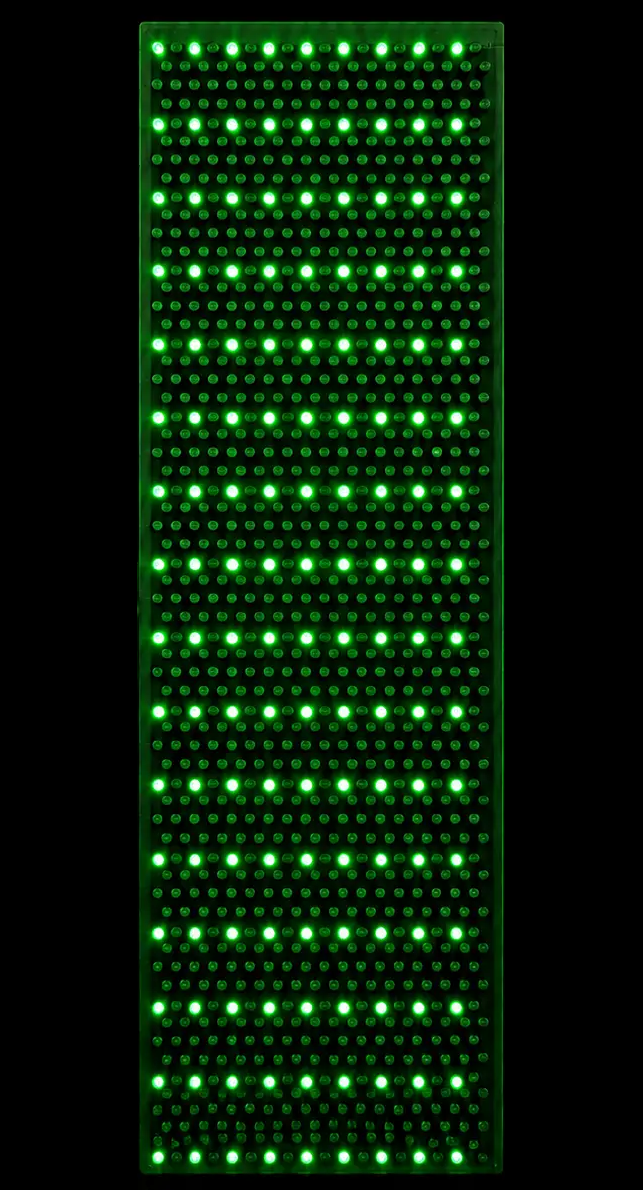
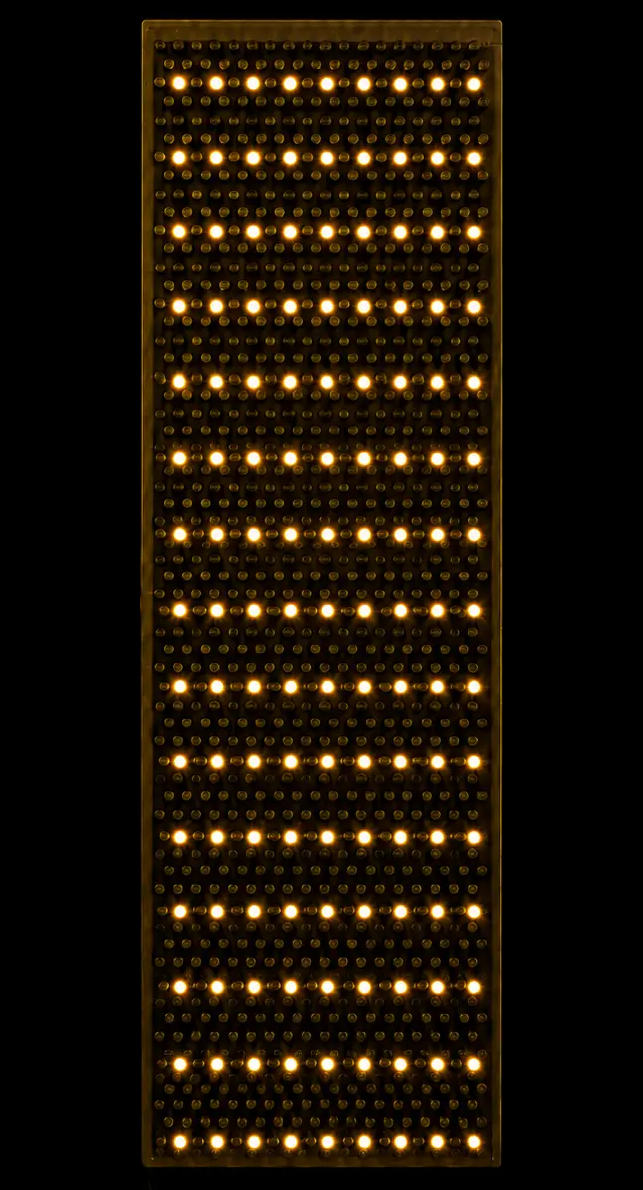
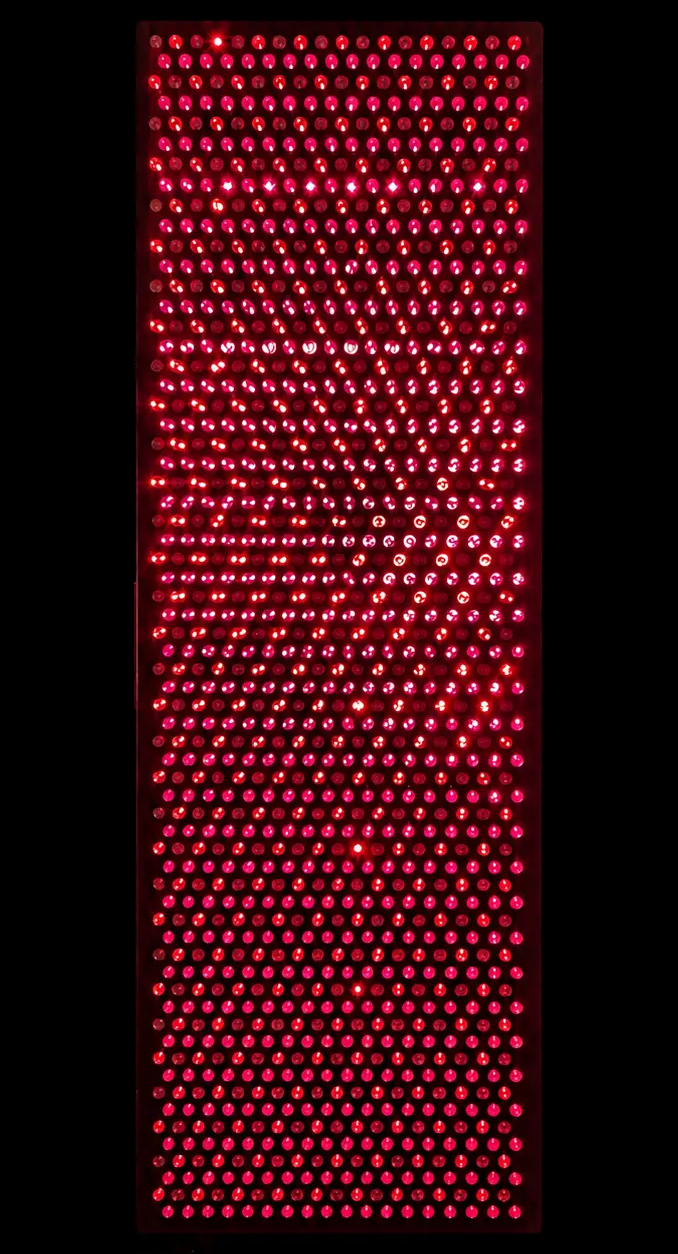
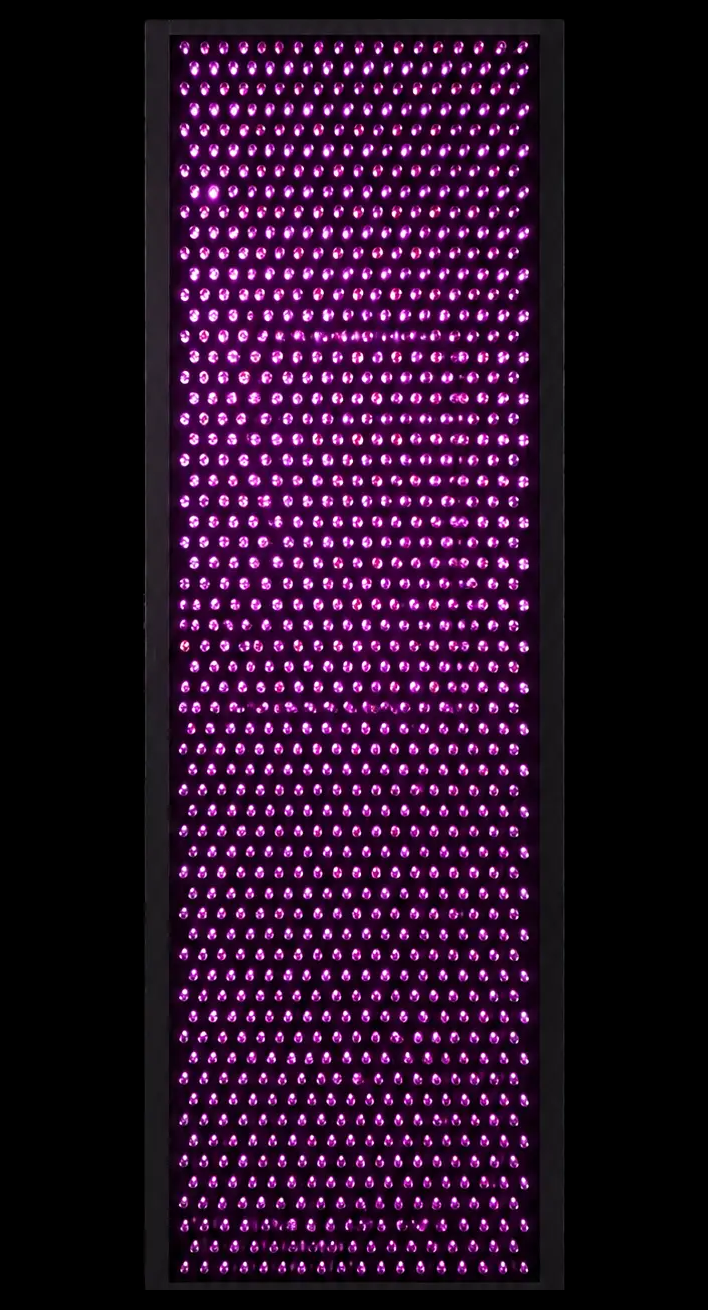
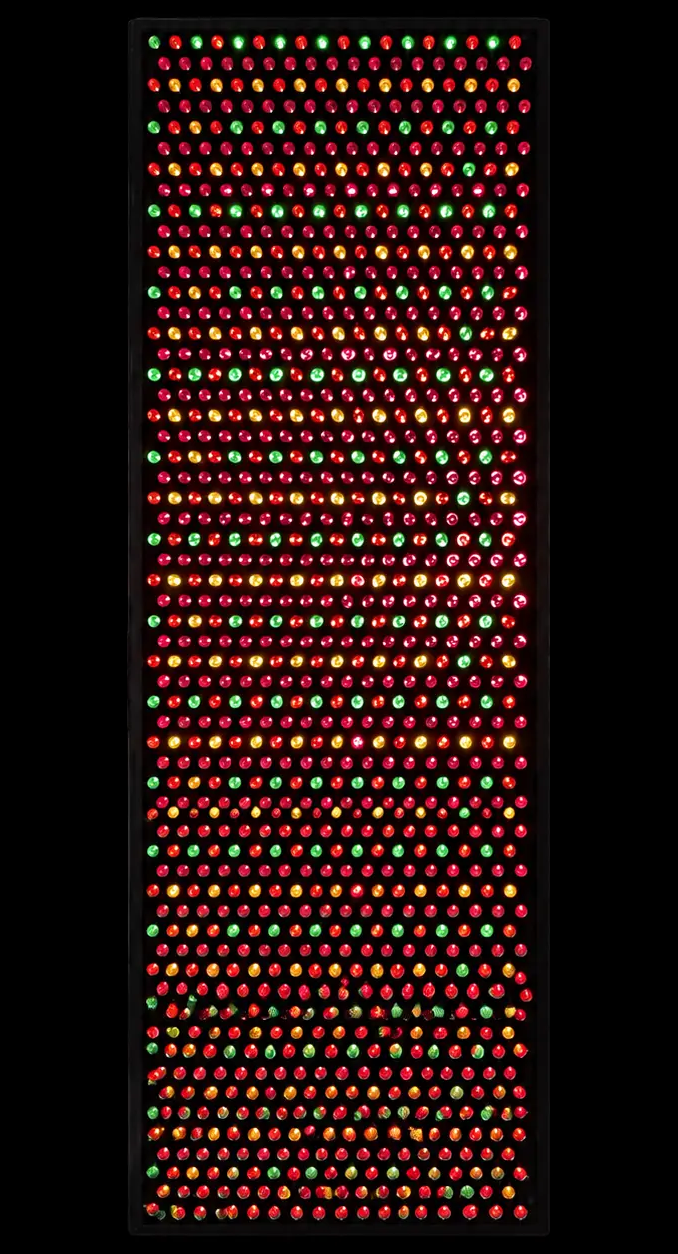
These examples show several wavelength modes available on the NrG Aura, Aurora, and Phoenix panels.

Standard and optional wavelengths

Why blue light is optional instead of standard.

Blue light is available on all NrG models by special request when the panel is pre-ordered. In a special-order configuration, blue light replaces the standard 530 nm green channel.

Optional wavelength
480 nm
Blemish-prone cosmetic skincare

480 nm · Blue

Cosmetic & research focus
  • Cosmetic skincare for blemish-prone skin
  • Clearer-looking complexion
  • Surface-focused visible-light skincare
  • Blue-light research involving bacteria-associated blemishes
  • Customizable blue-and-red cosmetic sessions

Blue-light research has explored bacteria-associated blemishes, but results are wavelength- and dose-specific. NrG's optional channel is 480 nm and is presented for cosmetic skincare, not as an acne-treatment or bacteria-killing claim.

01

Blue light is a more specialized option

Blue-light devices have established, device-specific applications—most notably acne-focused products. That does not automatically make blue the best core channel for a large general-wellness panel intended for repeated use across many session types.
02

Its biological profile is dose-dependent

Published reviews describe both useful blue-light effects and the potential for oxidative stress or pigmentation responses depending on wavelength, intensity, exposure time, and skin context. Blue is not inherently “bad,” but it deserves a more purpose-specific protocol.

03

Standard configurations use 530 nm green

Green gives the visible spectrum a distinct research channel beyond red and near infrared. When blue light is requested at the time of pre-order, the blue channel is installed in place of the standard 530 nm green channel.

The practical takeaway: NrG does not claim that more wavelengths are automatically better. Each standard configuration uses its listed purpose-selected channels and gives the user control over which ones are active, their intensity, pulse, time, and working distance. Blue light is available on all models by special request when the panel is pre-ordered and replaces the standard 530 nm green channel.
FDA blue-light acne-device classification → · Blue-light phototherapy review →
Photobiomodulation fundamentals

Light can act as a biological signal.

In red and near-infrared photobiomodulation research, mitochondrial photoacceptors and downstream signaling are leading parts of the mechanistic model. No single mechanism explains every wavelength or tissue.

01

Photons interact with endogenous chromophores

Red and near-infrared light can be absorbed by light-sensitive molecules in tissue. Cytochrome c oxidase is one of the most studied candidates, alongside other proposed pathways.

02

Cell signaling can change

Research has examined changes in mitochondrial activity, ATP production, nitric-oxide signaling, reactive oxygen species, calcium signaling, and downstream transcription.

03

Wavelength, dose, and tissue all matter

Green, yellow, red, and near-infrared light do not necessarily behave through the same dominant pathways. Biological response depends on the optical and biological context.

2024 PBM mechanism overview → · CCO / nitric-oxide evidence review →
Dose & control

More power is not automatically more effective.

PBM studies use widely different wavelengths, irradiances, fluences, pulse settings, distances, and exposure times. There is no single universal protocol, which is exactly why controllability matters.

Irradiance is the delivery rate

Irradiance describes optical power density at the measurement plane. Higher irradiance delivers energy faster, but it is not a stand-alone measure of biological effectiveness.

Time changes total energy

A joule measures energy accumulated over time. In light therapy, total energy delivered to each square centimeter is commonly called fluence or dose and is expressed in joules per square centimeter (J/cm²). For continuous output: dose (J/cm²) = irradiance (mW/cm²) × time (seconds) ÷ 1,000. For example, 50 mW/cm² delivered for 200 seconds equals 10 J/cm².

Distance and geometry change exposure

Panel size, lens design, angle, body position, and working distance all affect how much light reaches the target area.

Control gives you useful headroom

Independent wavelength intensity, pulse, timer, and working distance let you change the session instead of being locked into one fixed recipe.

Review of PBM parameters →
Measured output

Two readings. One panel. The measurement method matters.

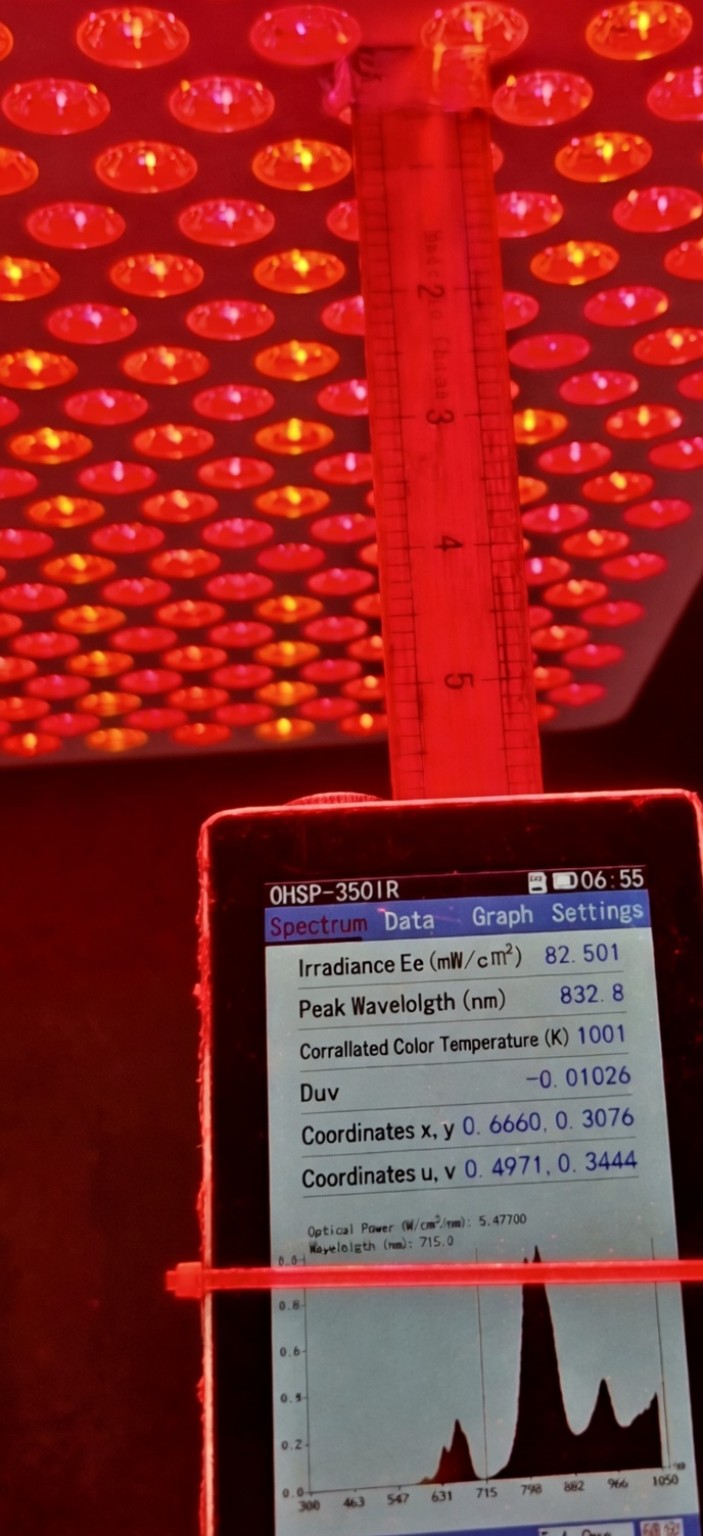
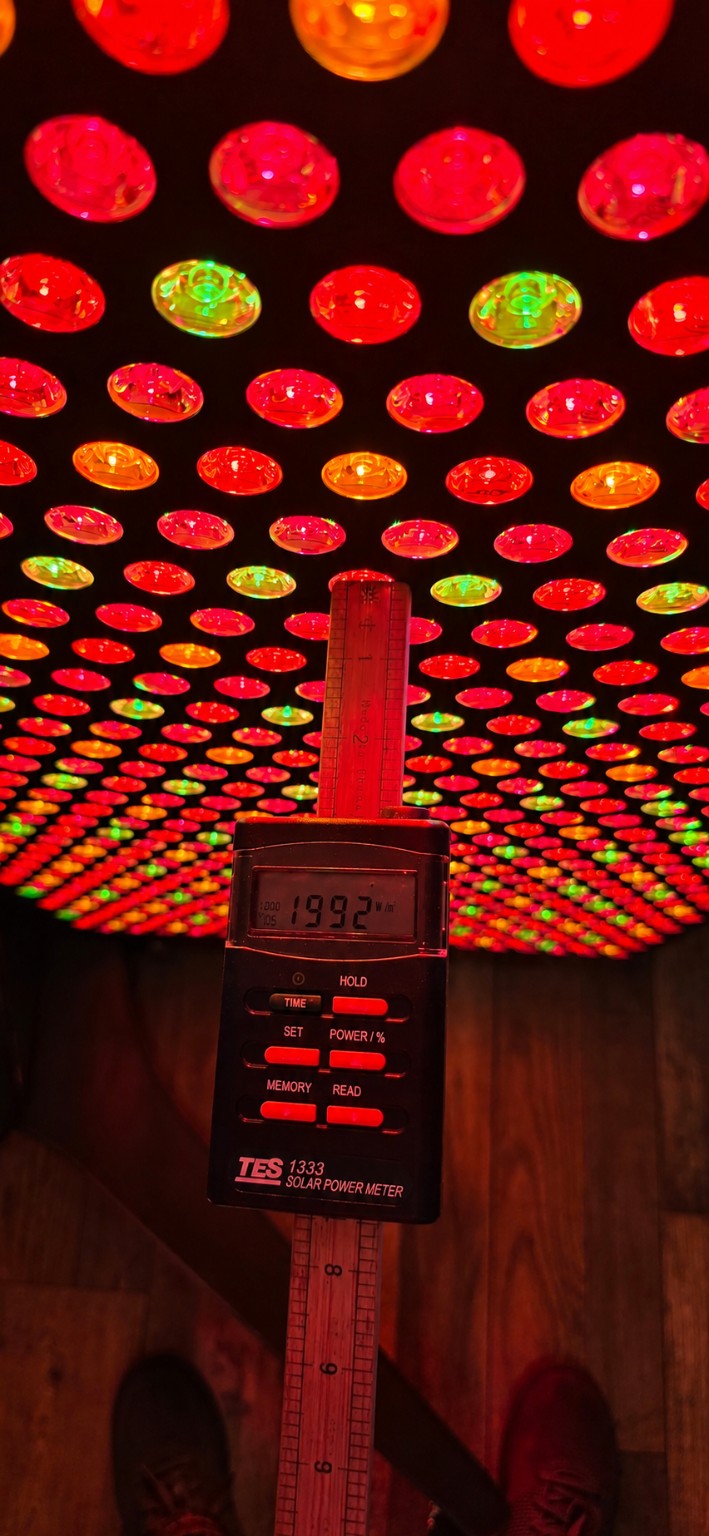
The NrG Phoenix measured 82.501 mW/cm² at 6 inches on an OHSP-350IR spectrometer. At 3 inches, the TES-1333 solar power meter displayed 1992 W/m²—the equivalent of 199.2 mW/cm².

OHSP-350IR spectrometer measuring NrG Phoenix irradiance at 6 inches, reading 82.501 mW per square centimeter
Primary published measurement 82.501 mW/cm² OHSP-350IR spectrometer · 6 inches
Peak wavelength shown: 832.8 nm
TES-1333 solar power meter measuring the NrG Phoenix at 3 inches, displaying 1992 watts per square meter
Supplemental broadband reading 199.2 mW/cm² TES-1333 solar meter
Equivalent to 1992 W/m² · 3 inches
Measurement transparency

Why advertised irradiance numbers can look inflated.

Many red light therapy devices are advertised using only broadband solar-meter readings, measurements taken directly at or very close to an individual LED lens, or readings taken only 3 inches from a full-size panel. These methods can produce much higher values than a wavelength-resolved spectrometer measurement taken at a realistic working distance. When the instrument, distance, and measurement position are not disclosed, the number may overstate the uniform output reaching the treatment area and can make product comparisons misleading.

Solar-meter readings are not inherently useless, but they require context. The TES-1333 is designed around measuring sunlight, so its sensor can weight concentrated red and near-infrared wavelengths differently than a spectrometer designed to measure irradiance by wavelength.

For transparent comparison, NrG also provides TES-1333 solar-meter readings at 3 inches and clearly labels them as supplemental. Our primary performance standard—and our gold-standard reference—is a wavelength-resolved OHSP-350IR spectrometer measurement taken at 6 inches for panel systems and 3 inches for portable devices.

Publish the instrument

An irradiance number is more useful when the meter type and measurement distance are disclosed.

Publish the distance

Output at the body changes with working distance, so a number without distance is difficult to compare.

Use output as one part of the protocol

Wavelength, irradiance, time, distance, pulse, geometry, and target tissue all matter when interpreting PBM research.

Why spectral response matters with LEDs → · PBM parameter review →